
How to Recognize, Understand, and Style 11 Essential Silhouettes
Still mixing up camisoles, tank tops, blouses, and button-front shirts? Watch our short video to see every essential top in seconds. Save it as your personal fashion vocabulary guide.
Before you can build a great wardrobe, you need to understand the language of clothing.
And tops are where fashion terminology becomes especially interesting, because the names do not always describe the same thing.
A halter is identified by its neckline.
A crop top is identified by its length.
A bodysuit is identified by its construction.
A peplum is identified by its silhouette.
This means one garment can be a halter top, a crop top, and a bodysuit all at the same time.
Once you understand that, shopping becomes easier, styling becomes more intentional, and you can finally explain exactly why one top works beautifully with an outfit while another does not.
1. The T-Shirt
The T-shirt is the foundation of the modern casual wardrobe.
It is traditionally made from a soft knitted fabric, with a simple body, short sleeves, and a neckline such as a crew neck, V-neck, scoop neck, or boat neck. Its name comes from the basic “T” shape created by the body and sleeves.
But not every T-shirt communicates the same message.
A lightweight, close-fitting T-shirt can feel polished and minimal. An oversized graphic tee feels relaxed, youthful, and streetwear-inspired. A heavyweight T-shirt has more structure, allowing it to sit away from the body rather than clinging to it.
The Adidas example is specifically presented as a heavyweight merchandise tee in cream white, giving the familiar T-shirt a more substantial, streetwear-oriented presence.
What it does to an outfit
A T-shirt lowers the formality of an outfit. It can make tailored trousers feel more effortless, soften a serious blazer, or bring a youthful energy to a formal skirt.
The styling rule
When the T-shirt is oversized, keep at least one other part of the outfit visually controlled. Try structured trousers, fitted shorts, or a slim skirt.
When it is fitted, you can introduce volume through wide-leg jeans, a full skirt, or an oversized jacket.
A T-shirt is simple, but the weight, fit, neckline, sleeve length, and shoulder placement determine whether it looks polished, sporty, vintage, or deliberately oversized.
2. The Tank Top
A tank top is a sleeveless top with visible shoulder straps. Those straps are generally wider and more substantial than the delicate straps of a camisole.
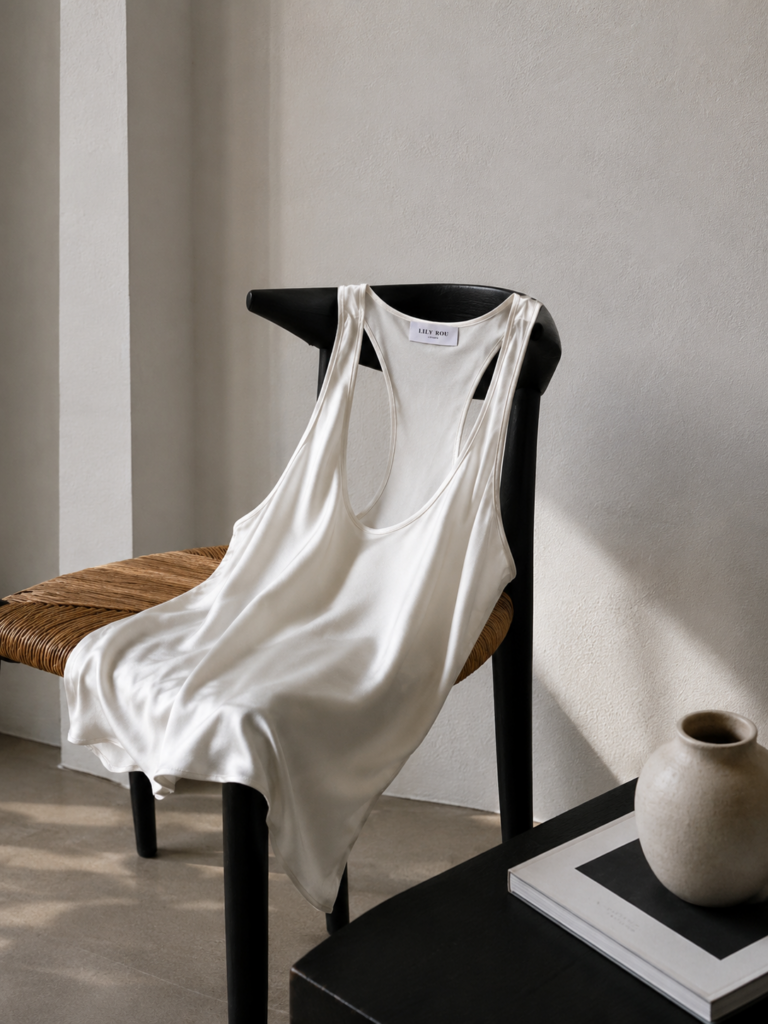
Tank tops can have a standard back, scoop neck, racerback, high neck, square neck, or athletic cut.
The silk example you selected demonstrates how elevated this category can become. It has a classic round neckline, low racerback, relaxed bias-cut shape, and is made from silk rather than traditional cotton jersey.
What it does to an outfit
A tank exposes the arms and brings attention toward the shoulders and upper torso. A high-neck tank creates a clean, modern line, while a scoop-neck version feels softer and more relaxed.
A racerback pulls the visual line inward behind the shoulders, which can make the shoulder area appear more defined.
The styling rule
A fitted ribbed tank is excellent under tailoring because it creates a clean base without competing with the jacket.
A fluid silk tank should be treated more like an elegant blouse. Pair it with tailored trousers, a long skirt, refined jewellery, or a softly constructed suit.
The fabric decides whether a tank reads as an underlayer, sportswear, or eveningwear.
3. The Camisole
A camisole—or cami—is a lightweight sleeveless top traditionally recognized by its thin spaghetti straps.
It often has a delicate, lingerie-inspired quality. Common details include lace edging, satin fabric, a softly draped neckline, small bows, or a close-fitting shape.
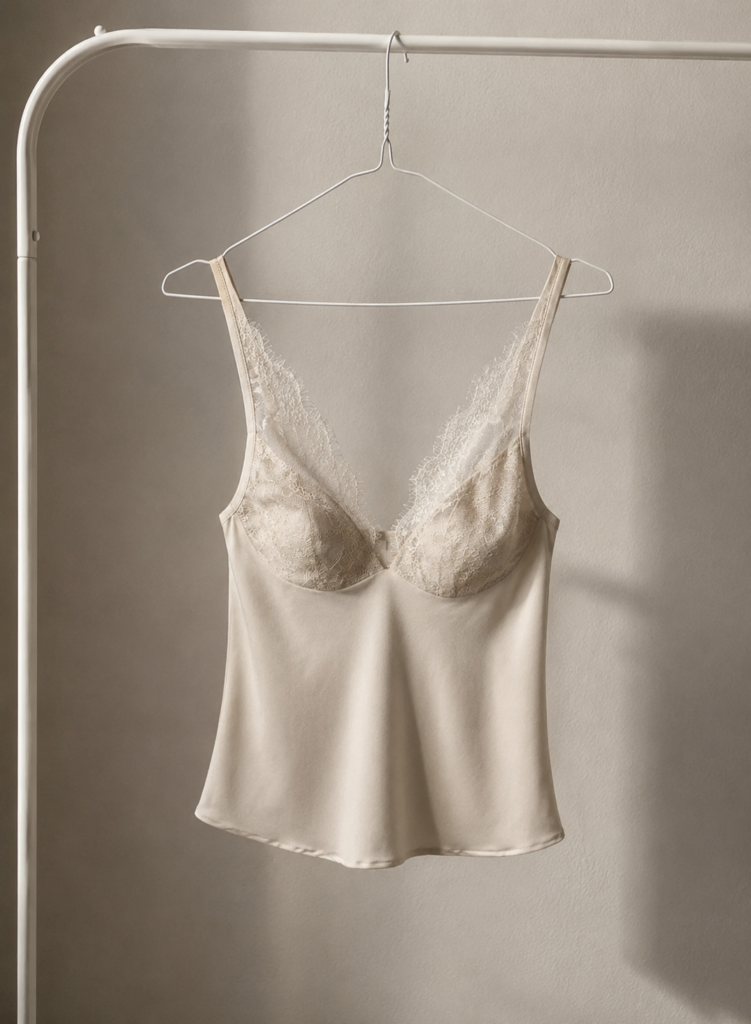
Your selected example uses spaghetti straps, contrast lace, and a fitted silhouette, all details commonly associated with the camisole family.
Tank top versus camisole
This is one of the most common fashion confusions.
A tank top usually has wider straps and often feels sportier or more substantial.
A camisole usually has very thin straps and feels lighter, softer, or more lingerie-inspired.
However, retailers sometimes use the names interchangeably. Look at the garment’s construction rather than trusting the product title alone.
The styling rule
The secret to wearing a lingerie-inspired camisole outside the bedroom is contrast.
Pair softness with structure:
- A lace camisole with tailored trousers
- A satin camisole beneath a masculine blazer
- A delicate cami with rigid denim
- A fitted camisole with a substantial leather or suede jacket
The contrast prevents the outfit from looking overly sweet or unfinished.
4. The Tube Top
A tube top is a strapless garment that wraps around the upper torso.
The most basic version resembles a simple tube of stretch fabric, but modern interpretations can include internal structure, seams, boning, shaping panels, side zippers, or tailored construction.
The Aritzia example is a sophisticated interpretation rather than a basic elastic tube. It is lined and strapless, with princess seams that shape the silhouette, side slits, and a softly textured linen fabric with some stretch.
Tube top versus bandeau
A bandeau is usually shorter and may cover primarily the bust area.
A tube top generally extends farther down the torso, although contemporary retailers often use the two terms interchangeably.
What it does to an outfit
A strapless neckline creates one uninterrupted horizontal line across the upper body. It exposes the shoulders, collarbones, and neck, making jewellery and hairstyle particularly important.
The styling rule
Because a tube top leaves the upper body visually open, it works beautifully with:
- A sculptural necklace
- Statement earrings
- A sleek bun or polished ponytail
- High-waisted trousers
- A long, fluid skirt
- An oversized shirt or blazer worn open
For a refined result, pay attention to support and fit. A strapless top should remain secure without excessive pulling, adjusting, or compression.
5. The Halter Top
A halter top is defined by the way it connects around or behind the neck, leaving much of the shoulders and upper back exposed.
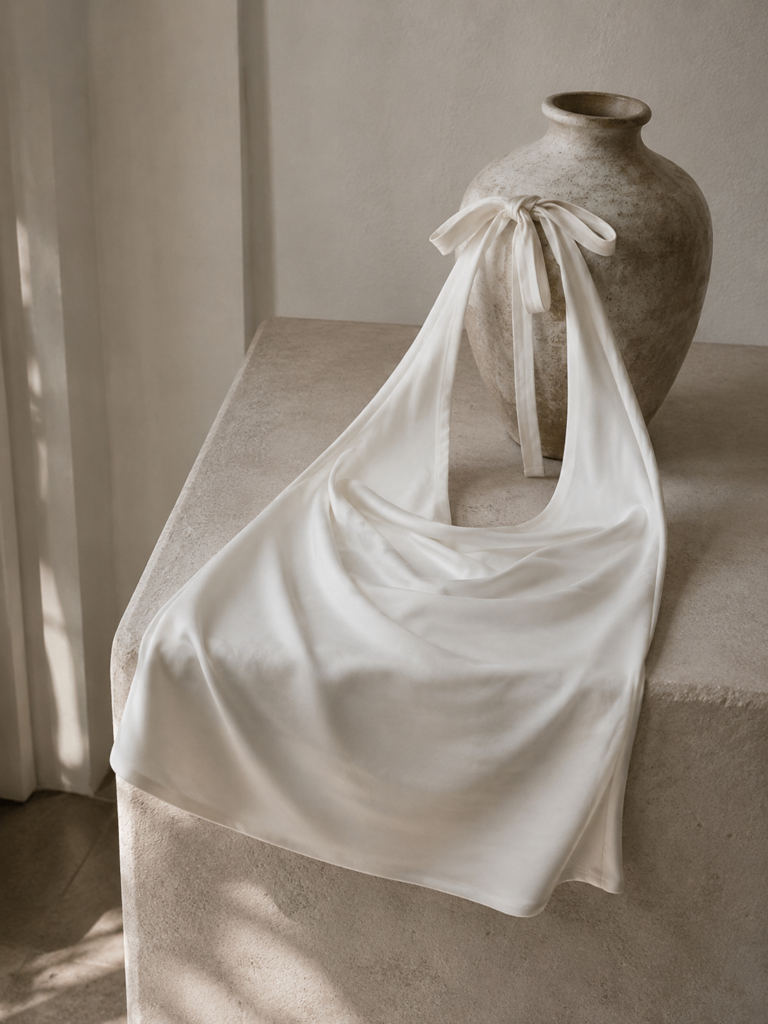
Some halters tie at the neck. Others use a fixed strap, twisted neckline, gathered band, or high-neck construction.
The Oak + Fort example has a relaxed shape and an adjustable tie neckline, allowing the wearer to control how the neckline sits.
What it does to an outfit
A halter directs the eye toward the face, neck, shoulders, and upper back.
Because the fabric often moves inward toward the neck, it may visually emphasize the shoulder line. It can feel athletic, glamorous, minimalist, or resort-inspired depending on the fabric.
The styling rule
Let the neckline remain the focal point.
Traditional necklaces can compete with a halter, especially when fabric already wraps around the neck. Instead, consider earrings, cuffs, rings, or an elegant hairstyle.
A fluid halter works well with wide trousers or a column skirt. A fitted halter can be balanced with more volume below the waist.
6. The Crop Top
A crop top is any top designed to end higher than the length of a conventional shirt.
Some finish just above the natural waist. Others expose more of the midriff. A crop top can be a cropped T-shirt, blouse, sweater, tank, corset, jacket, or halter.
This is why “crop top” describes length, not one particular design.
The Stay Close example illustrates the overlap between categories: it is cropped, but it also has a halter neckline, draping across the chest, a body-contouring shape, and a deep open back.
What it does to an outfit
A shorter top changes where the torso appears to end and where the legs appear to begin.
When combined with high-waisted bottoms, it can create a longer-looking leg line because the visible waistline sits higher on the body.
The styling rule
You do not need to expose a large section of the stomach to wear a crop top.
Pairing a slightly cropped top with high-rise trousers or a high-rise skirt may reveal only a narrow line of skin—or none at all.
The most sophisticated crop-top outfits often rely on proportion rather than exposure:
shorter top + higher waist + longer lower silhouette.
7. The Bodysuit
A bodysuit is a one-piece garment that continues below the torso and fastens or closes around the crotch.
Unlike a tucked-in top, it stays smooth and secure throughout the day. It does not bunch around the waist or repeatedly pull out of trousers and skirts.
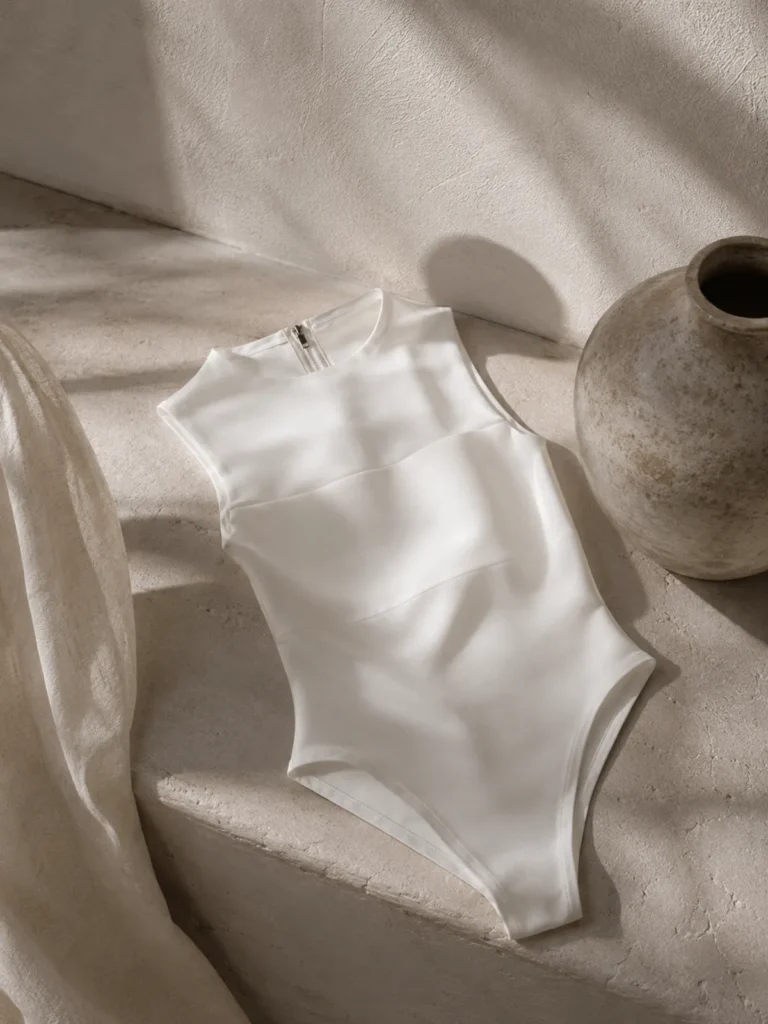
A bodysuit may have almost any neckline: crew neck, scoop neck, halter, square neck, strapless, one-shoulder, or button-front.
The selected Alice + Olivia piece is categorized as a bodysuit while also being described as fitted, sleeveless, high-necked, and slightly sheer. This demonstrates an important point: bodysuit describes the garment’s lower construction, not its neckline.
What it does to an outfit
A bodysuit creates an uninterrupted, controlled line through the torso.
It is especially useful with:
- Tailored trousers
- Low- or mid-rise bottoms
- Slim skirts
- Layered suits
- Belts
- Garments in which visible bunching would disrupt the silhouette
The editor’s styling rule
Think of a bodysuit as a styling tool rather than one particular aesthetic.
A cotton bodysuit can be casual. A draped bodysuit can replace an evening blouse. A sheer bodysuit can act as a layering piece. A square-neck bodysuit can create a clean, almost corseted frame.
8. The Blouse
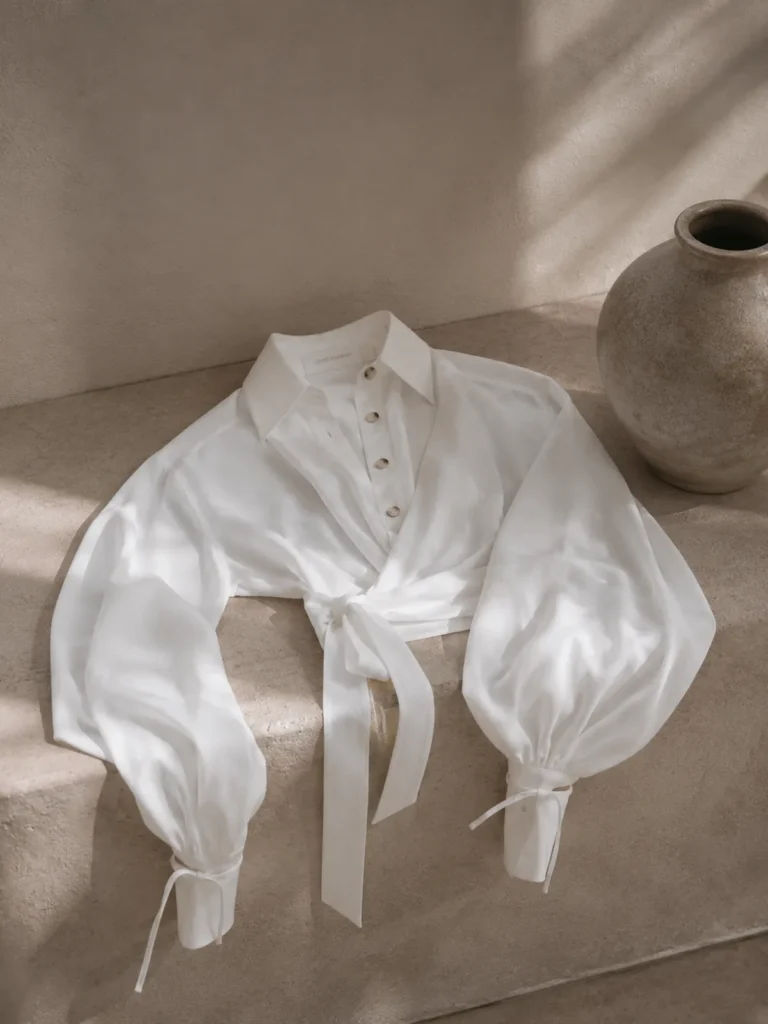
A blouse is generally a more decorative, fluid, or design-led top than a conventional shirt.
It may include gathering, draping, bows, ruffles, embroidery, lace, wrap construction, statement sleeves, or softer fabrics.
However, a blouse can still have a collar and buttons.
The Zimmermann example combines classic shirting elements with unmistakable blouse details. It has a collar and functional front buttons, but it also features exaggerated blouson sleeves, elongated cuffs, gathering, a cropped shape, and a wrap waist tie.
Blouse versus shirt
A shirt usually begins with a more structured, utilitarian construction.
A blouse gives the designer greater freedom to introduce softness, volume, ornamentation, or unusual shaping.
The distinction is not always strict, but ask yourself:
Does the garment feel primarily tailored and shirt-like, or does its personality come from draping, volume, decoration, and silhouette?
The styling rule
When the blouse has dramatic sleeves, ruffles, or a strong wrap detail, simplify the rest of the outfit.
Let one area hold the volume.
A voluminous blouse looks especially modern with straight trousers, a narrow skirt, or clean denim rather than equally voluminous bottoms.
9. The Button-Front Shirt
What many people call a “button-down shirt” is more accurately called a button-front or button-up shirt.
Technically, “button-down” originally refers to a collar whose points are fastened to the shirt with small buttons. In everyday fashion language, however, the term is now frequently used for almost any shirt with buttons running down the front.
A classic shirt normally includes:
- A collar
- A front button placket
- Sleeves with cuffs
- A yoke or structured shoulder area
- A relatively crisp construction
The Corinne example uses poplin to create a crisp base, then introduces knit panels, long sleeves, and gold front buttons for a more decorative finish.
What it does to an outfit
A button-front shirt brings order and structure.
Worn fully buttoned, it feels precise. With several buttons undone, it becomes relaxed. Tucked in, it defines the waist. Worn open, it becomes a lightweight layer.
The styling rule
A shirt should not always be styled in its most predictable form.
Try it:
- Open over a fitted tank
- Half-tucked into jeans
- Tied at the waist
- Layered beneath a strapless dress
- Worn backward for an editorial image
- Oversized with narrow trousers
- Buttoned to the collar with strong earrings
The white or ecru shirt is not boring. It is a blank styling surface.
10. The Tunic
A tunic is a long, relatively loose top that extends below the usual shirt length—often covering the hips and sometimes reaching the upper thigh.
A tunic may have sleeves or be sleeveless. It can be tailored, bohemian, knitted, sheer, belted, embroidered, or shirt-inspired.
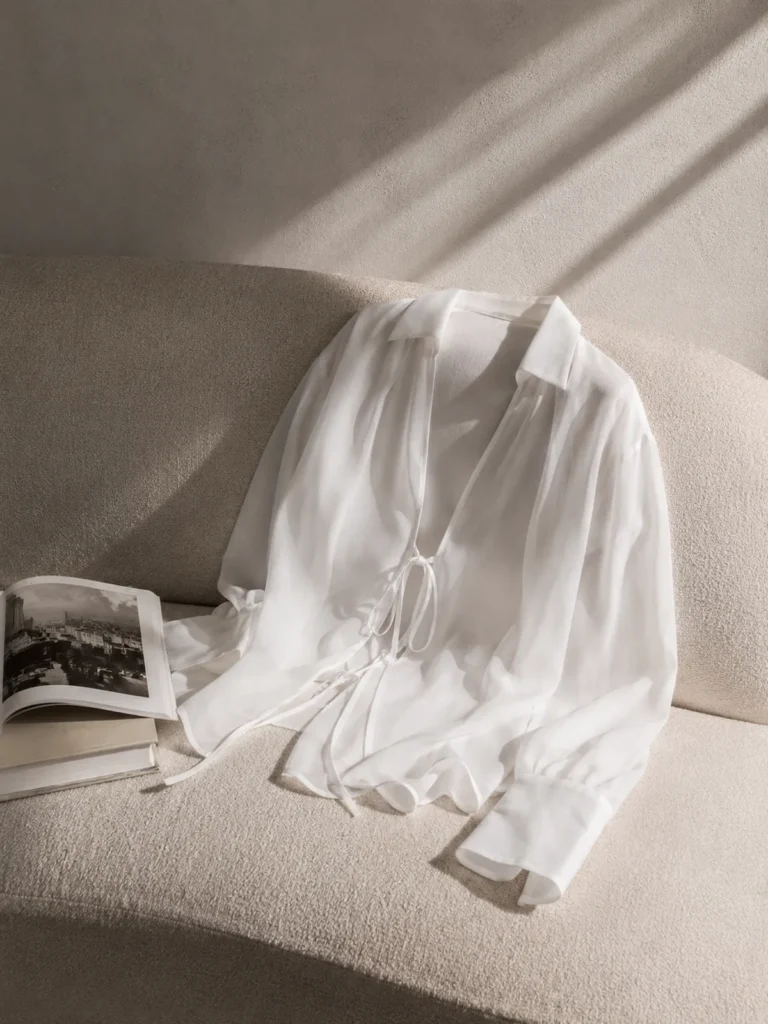
The Jaclyn example is designed as a swim cover-up and includes a relaxed fit, dropped shoulders, a collar, cuffs, and a tie-front closure. Its lightweight translucent fabric allows it to be worn open or closed over swimwear.
Tunic versus mini dress
The difference is not always obvious.
A mini dress is designed to function independently as a complete garment. A tunic is generally intended to be worn over another layer, such as trousers, leggings, shorts, or swimwear.
Coverage, side openings, fabric transparency, and the designer’s intended styling all help determine the category.
The styling rule
Because a tunic creates length through the torso, pay attention to what happens underneath it.
A long, loose tunic usually benefits from a cleaner lower silhouette: straight trousers, narrow pants, shorts hidden beneath the hem, or a swimsuit.
A belt can transform a tunic by introducing waist definition, but leaving it unbelted creates a more relaxed, column-like line.
11. The Peplum Top
A peplum top is fitted or defined around the waist and then flares outward through an additional section of fabric.
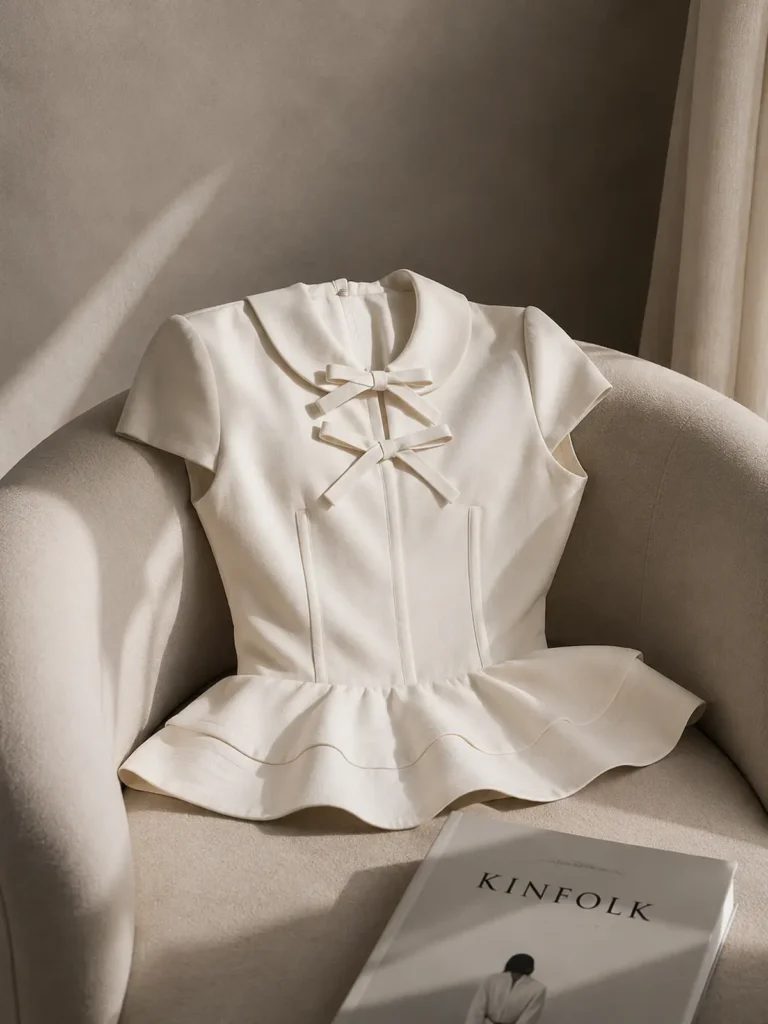
The flare may be gathered, pleated, circular, asymmetrical, sculpted, or softly draped.
The peplum may begin at the natural waist, just below the bust, or lower around the hips. Its placement dramatically changes the proportions of the garment.
What it does to an outfit
A peplum emphasizes the waist by creating contrast between a narrower centre and a fuller lower section.
It can also introduce shape or volume around the hip area.
A structured peplum feels architectural and polished. A soft peplum feels romantic and fluid. An asymmetrical version can look directional and editorial.
The styling rule
Because the peplum already contributes volume, streamlined bottoms usually create the cleanest balance.
Try it with:
- Straight-leg trousers
- Slim cigarette pants
- A pencil skirt
- Clean, dark denim
- A narrow maxi skirt
Avoid placing a heavy belt directly over a complicated peplum unless the belt is part of the intended design. The waist is already being visually articulated.
The Five Distinctions to Remember
Tank top versus camisole
A tank usually has wider straps and a sportier or more substantial construction. A camisole usually has thin straps and a more delicate, lingerie-inspired quality.
Tube top versus bandeau
Both are strapless. A bandeau is usually shorter, while a tube top generally extends farther down the torso.
Blouse versus shirt
A shirt is usually more structured and based on traditional shirting construction. A blouse often introduces more draping, decoration, volume, or softness.
Crop top versus every other top
“Crop” only tells you that the garment is shorter. A crop top can also be a T-shirt, blouse, tank, halter, or bodysuit.
Tunic versus dress
A tunic is generally designed for layering. A dress is designed to function as the primary garment.
The Final Formula
When identifying any top, examine five things:
1. Neckline
Is it crew, V-neck, square, halter, strapless, scoop, or boat neck?
2. Sleeve and strap construction
Does it have sleeves, wide straps, spaghetti straps, or no straps?
3. Length
Does it end at the waist, above the waist, at the hips, or below the hips?
4. Shape
Is it fitted, straight, oversized, draped, wrapped, or flared?
5. Construction
Is it a separate top, a bodysuit, a button-front shirt, or a garment designed for layering?
That is how a fashion editor reads clothing.
Not simply by asking, “What is this top called?”
But by understanding its neckline, length, construction, fabric, silhouette, and the visual message it creates.
Watch our accompanying short video to see all 11 tops—from the everyday T-shirt and delicate camisole to the sculptural peplum and elongated tunic.